Hey there, quick question – if you’ve ever pulled up to a CNG station on a 95°F (35°C) summer day and noticed the pump taking a little longer to fill your tank than it does in the dead of winter, you’re not crazy. I’ve been in the CNG station supplier game for over a decade, and let me tell you, hot weather is one of the trickiest pain points we deal with on the regular. A lot of folks ask me how our stations (and the whole CNG supply chain) handle those sweltering days when heat can turn a smooth fill into a headache. Today, I’m breaking down exactly what goes on behind the scenes to keep your CNG station running when the sun’s beating down like crazy. CNG Station
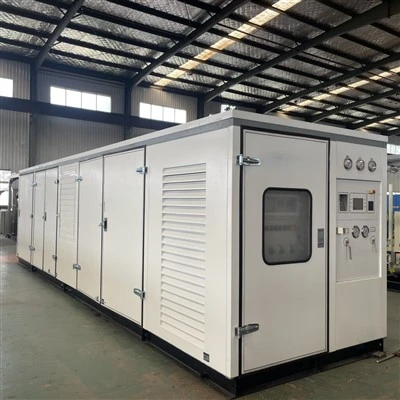
First, let’s get one key thing straight: CNG is compressed natural gas, right? We compress natural gas down to about 3,600 psi to store it in those big steel tanks we call storage cascades. Now, here’s the science part that makes summer a problem – gases expand when they get hot. If you’ve ever taken a fully inflated basketball outside on a cold day and watched it deflate, or left a soda can in the car that blew up (okay, that’s a mess), that’s Charles’s Law at work. That same rule applies to CNG. When the temperature spikes, the pressure inside those storage tanks and even the vehicle’s fuel tanks goes up way faster than we want it to. If we don’t adjust, we could have too much pressure in the cascade, which would make the safety valves kick in – and trust me, that’s not a good time, plus it means we can’t pump as much gas to customers. Also, if you try to fill a hot vehicle tank with hot CNG, the pressure rises so quick the pump will shut off early, leaving your customer with a partial fill. That’s a lost sale, and nobody wants that.
So what do we do about it? Let’s start with the big storage cascades, since that’s the backbone of any CNG station. The first line of defense here is pre-cooling the CNG before it hits the storage tanks or the pump. A lot of newer stations (the ones we supply, specifically) come skid-mounted pre-cooling units that chill the gas down to anywhere from 0°C to -5°C (32°F to 23°F) before compression. Wait, but why pre-cool it for summer? Well, if we take hot gas and compress it, it gets even hotter – compression itself generates heat. If that hot gas goes into the cascade, the warm ambient summer air heats it up even more, pushing pressure over the limit. Pre-cooling brings the gas down to a stable temp, so when we compress it, it doesn’t spike too bad, and the cascade can hold the full 3,600 psi all summer long. The pre-coolers run on refrigerant, similar to what’s in your home AC, and we size them specifically for the station’s location – if you’re in Arizona, where summer temps hit 110°F, you need a bigger pre-cooler than if you’re in Oregon, where it’s a little milder. We always tell our clients to match pre-cooler capacity to their local peak summer temps, and that’s saved so many stations from downtime during heatwaves.
Next up, the storage cascades themselves. A lot of people don’t realize that these tanks don’t live inside a climate-controlled building – they’re usually outdoors, right? So we make sure they’re properly shaded, or even paint them with special heat-reflective coating. That’s a game-changer. I worked with a client in Texas a couple years back who was losing 10-15% of their CNG capacity in the summer because their cascades were just sitting in the sun. We had a crew come out, spray them with that reflective coating (it’s silver, bounces the sun right off, and’s durable enough to last 5+ years), and overnight their pressure retention in summer went up to 98%. That’s a huge difference. We also recently started offering optional insulation jackets for smaller cascades in areas with extreme swings, but honestly, the reflective coating is way more cost-effective for most stations.
Now, when it comes to the pumps – that’s the part customers interact with, and we can’t forget about them. On a hot day, the CNG flowing through the pump lines can warm up as it moves from the cascade to the nozzle. We install insulated heat traces on the pump lines to keep that gas cool, and also have small chillers right at the pump assembly that maintain the gas temp at a steady 5°C (41°F) when it’s above 85°F. Another thing: we program the pump’s controller to adjust the fill rate based on ambient temperature. In cold weather, pumps fill fast – hot weather, they slow down a little, because if they push too much gas too quick, the temp spike in the vehicle tank is too high. That’s why you’ll notice longer fill times in summer, but it’s not the pump being broken – it’s it being smart, so the pressure stays safe and you get a full, correct fill.
Wait, let’s not forget about the fueling points for heavy-duty vehicles, like semi-trucks, that fill up with a lot more CNG in the summer. Those stations often have high-flow pumps, but on hot days, we recommend adding a secondary pre-cooler for the high-flow lines. A client in California that runs 24/7 heavy-duty routes told us last summer that their high-flow fills were only half as efficient in July, so we added that secondary chiller, and now they can keep up with their route trucks no matter how hot it gets. Also, safety is non-negotiable here. Every CNG station has pressure relief valves, but we calibrate those twice a year – once in spring before summer hits, and once in fall. When temps go up, those valves need to be set correctly to kick in if pressure gets too high, without leaking unnecessarily. We include that calibration service as part of our annual maintenance packages, because it’s way better to catch that when it’s not a 100°F day.
Another big one: the compressor itself. CNG stations rely on compressors to compress the raw gas from the pipeline or well into the high-pressure stuff we store. Compressors generate a ton of heat when they’re running, especially during summer when they’re working overtime to keep up with demand. We design our compressors with air-cooled aftercoolers, but for stations in super hot climates, we can swap those out for water-cooled aftercoolers, or add an extra cooling loop. A compressor that’s running too hot will struggle to compress gas efficiently – it might use 20% more energy, and break down more often. We had a client in Florida whose compressor was overheating every summer, so we retrofitted their cooling system, and their energy bills dropped by 18% that year, plus they had zero compressor downtime all summer. That’s a win-win for everyone.
Wait, are there any little things people don’t think about? Oh, the control room! The station’s main controller that monitors all the pressure, temp, and flow – that unit needs to be kept cool too. If the control room overheats, the sensors can go wacky, leading to wrong pressure readings, which can mess up the whole station’s operation. We always tell our clients to add a dedicated mini-split AC unit for the control room, not just rely on the station’s main HVAC. I’ve seen a station in Nevada go down for 12 hours once because their control room AC broke during a heatwave – that’s hundreds of dollars in lost revenue, just because of a $500 AC unit. We include that as a standard recommendation for all our new stations, so that doesn’t happen.
Let’s talk real-world examples, because I don’t like to just throw tech terms around. Last year, a client in Phoenix, where summer temps regularly hit 115°F, called us panicking because their station was operating at only 60% capacity during the day. We did a full audit: found their pre-cooler was too small for the peak summer load, their cascades had no reflective coating, and their pump lines were uninsulated. We sized up their pre-cooler, sprayed the cascades, insulated the lines, and adjusted the pump controller settings. Within a week, their capacity was back up to 95%, and they didn’t have a single pressure relief valve trip that entire summer. That’s the kind of fix we do every day.
Now, I know a lot of station owners might be worried about the cost of all this. Let’s be real – investing in cooling and maintenance for summer saves way more money than dealing with downtime, lost sales, or broken equipment. The pre-cooler units we supply have a 10-year warranty, the reflective coating lasts 5 years, and the retrofits usually pay for themselves in one summer from increased efficiency and less repairs. We also offer flexible financing options for all our stations and upgrades, so you don’t have to drop a huge lump sum all at once.
At the end of the day, hot weather is a challenge for CNG stations, but it’s not an unsolvable one. It’s all about proactive design, the right cooling components, and regular maintenance to adjust for the seasons. If you’re a station owner who’s been dealing with slow fills, pressure issues, or downtime when the sun’s blazing, or if you’re thinking about getting into the CNG game and want to make sure your station is built to handle heat, I’m here to help. We tailor every station and upgrade to your specific location, whether you’re in a desert climate, a humid southern state, or anywhere in between, so you can keep your station running smooth all year long.

If you want to chat about what your station needs to handle this summer – whether it’s a full system audit, a pre-cooler upgrade, or a new station build – reach out. We work with small independent stations, big fleet hubs, and everything in between, so we’ve got a solution that fits your needs and your budget. Don’t let hot weather be the reason your CNG station falls short – let’s get it set up to perform, no matter how high the thermometer climbs.
CNG Standard Station Reference:
Compressed Natural Gas Station Design and Operation Guidelines. American Gas Association, 2021.
OSHA Safety Standards for Compressed Natural Gas Fueling Stations. Occupational Safety and Health Administration, 2022.
Natural Gas Vehicle Fueling Infrastructure: Climate Adaptation Strategies. Department of Energy Office of Energy Efficiency and Renewable Energy, 2020.
Qingdao Lenado Intelligent Equipment Co., Ltd.
Qingdao Lenado Intelligent Equipment Co., Ltd. is one of the most experienced CNG station manufacturers and suppliers in China. We have world-leading production equipment and strong manufacturing capabilities. Please rest assured to wholesale bulk customized CNG station from our factory.
Address:
E-mail: genkegasstation@163.com
WebSite: https://www.cnggasstation.com/
